As international trade and the digital economy grow, Uzbekistan is reinforcing its connections with the global banking system, and Octobank is stepping up its dialogue with international financial institutions
Over many years, Central Asia was present on the international financial agenda mainly in relation to remittances, commodity markets and regional trade. Today, this picture is changing step by step.
At Sibos Miami 2026, Octobank, taking part in one of the world’s biggest financial industry forums for the third year running, offered a broader agenda: Central Asia is growing into an increasingly developed and technology-oriented financial market, and the region’s future growth requires tighter integration of local banks with global banking and payment infrastructure.
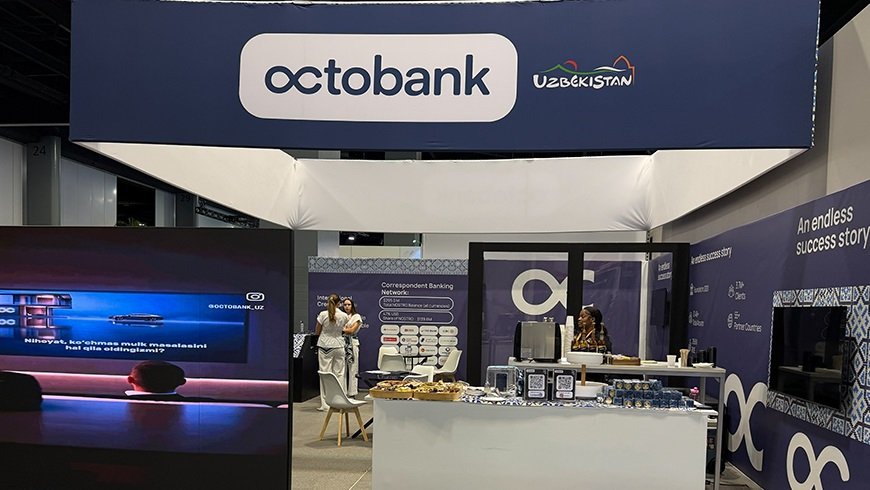
The bank’s presence in Miami included its own 48 sq. m stand, which brought together exhibition and meeting zones for meetings with international financial institutions, payment companies and technology partners.
The main substance of the bank’s participation, though, was not the stand or its look, but the business dialogue that unfolded around it.
From Remittance Flows to Modern Financial Infrastructure
Octobank’s agenda at Sibos was built around the areas that serve as the basis of international banking cooperation: correspondent banking, cross-border payments, clearing, foreign exchange operations, liquidity management and financial services for companies operating in international markets.
The bank further indicated its interest in developing new payment routes and expanding cooperation with foreign financial institutions.
This agenda reflects more fundamental changes under way in Uzbekistan’s economy.
As international trade, e-commerce and cross-border business activity expand, local businesses require wider access to international settlements, multiple currencies, global payment systems and banking partners capable of supporting operations in several jurisdictions simultaneously.
For international banks, Uzbekistan is, in turn, becoming an ever more attractive market that remains relatively weakly represented on the global financial agenda, even with its strategic position between the major economic centers of Asia, the Middle East and Europe.
Octobank regards this gap as an opportunity for further growth.
“Uzbekistan is becoming an increasingly visible part of international trade, and banking infrastructure must match this level of integration.
For Octobank, it is important not simply to be present on the global financial agenda, but to build concrete connections with international banks and payment companies that help businesses operate faster, more reliably and more efficiently in foreign markets,” remarked Hamid Jumaev, First Deputy Chairman of the Management Board of Octobank.
Growing in Step with the Market
Octobank’s international strategy is supported by a growing domestic business. Bank data as of September 2026 show that Octobank’s assets amount to around USD 1.66 billion, its client base exceeds 4.9 million people, and the bank maintains relationships with 19 correspondent banks and cooperates with more than 30 financial institutions.
One of the bank’s international priorities is to further develop correspondent and settlement infrastructure in the leading global currencies, specifically US dollars, euros and Chinese yuan. These figures are meaningful not only as a description of the bank’s scale.
They show that Octobank’s international development is connected not with an image-building presence abroad, but with the real needs of businesses and its client base. For a bank serving millions of clients and a growing corporate segment, a more developed network of international financial connections directly shapes payment speed, transaction costs, access to currencies and the ability of Uzbek companies to operate in foreign markets.
Why Central Asia Is Becoming More Significant for Global Finance
A combination of factors is shaping the region’s significance. Trade routes are changing. E-commerce is on the rise. Central Asian companies are working more actively beyond their national markets. Financial technologies are reducing the weight of geographic distance.
At the same time, banks must be capable of connecting markets that were historically linked through longer and more complex intermediary chains. That is why the previous idea of Central Asia as primarily a remittance market is gradually becoming out of date.
The next stage of development is financial connectivity. What this means is direct relationships between banks, broader access to clearing, faster cross-border settlements, and the development of foreign exchange infrastructure, treasury services and payment technologies for business and retail clients.
For international financial institutions, this gives rise to a different question. Not only: “How big is the Central Asian market today?” But also: “Which financial institutions will provide the infrastructure as new trade and payment flows grow?”
The Financial Silk Road of Today
Octobank structured its participation in Sibos around the idea: “Uzbekistan — the New Silk Road of Digital Finance.” The choice of this historical analogy was deliberate.
For centuries, the Silk Road connected economies, transporting goods, capital and information between markets. Today, a considerable portion of such connections is moving into the digital sphere. A modern trade corridor can no longer be thought of as merely a system of roads, railway routes and logistics centers. It also depends on the capacity to move money between countries quickly and effectively.
This calls for banks. It calls for settlement infrastructure. It calls for financial control and compliance systems. It calls for international payment networks. And, especially important, it calls for relationships of trust between financial institutions in different countries.
For Uzbekistan, developing such relationships is becoming part of the country’s broader integration into the global economy. Octobank aims to become one of the financial institutions that ensure this
process.
More Than a Stand
At Sibos, Octobank sought to tie the international banking agenda to the broader story of modern Uzbekistan. The stand’s design made use of national elements, visitors were offered traditional Uzbek sweets, and the business program was paired with an opportunity to learn about the country’s culture.
- At first glance, this may be seen as a standard element of an exhibition.
- In international positioning, however, it serves a deeper purpose.
- Many in the global banking community still lack direct experience of working with Uzbekistan.
- That is why Octobank’s task is not only to present the bank as such.
- It also has to introduce international audiences to the market standing behind it.
What Happens Once Sibos Is Over
The real value of any major international banking forum is not determined by the number of meetings held during the event, but by what happens after it concludes.
For Octobank, the outcome of Sibos will depend on the degree to which the negotiations in Miami develop into long-term relationships with international banks, financial institutions, payment companies and technology partners.
Further dialogue may extend to areas such as correspondent banking, clearing, payment infrastructure, foreign exchange operations, liquidity management and financial technology cooperation. The bank itself emphasizes that its international strategy is not restricted to building awareness.
The goal is for the dialogue that started at Sibos to be continued in practice. This distinction is of fundamental importance. Because the wider story is not that an Uzbek bank took part in a large international event. It is that financial institutions from markets like Uzbekistan are gradually beginning to play a more direct part in the global financial infrastructure.
As Central Asia’s integration into international trade and the digital economy deepens, this process will become more and more visible. The historical Silk Road linked economies through trade. Its contemporary counterpart is increasingly shaped through payments, clearing, technology, data and direct banking relationships.
About Octobank
Octobank is a private commercial bank whose headquarters are in Tashkent, Republic of Uzbekistan.
Founded in 2001, the bank completed a rebranding in 2023 under the name Octobank. Today, it develops digital banking, payment infrastructure, corporate services and international financial operations.
Bank data as of September 2026 show that Octobank’s assets amount to approximately USD 1.66 billion, its client base exceeds 4.9 million people, and the bank maintains relationships with 19 correspondent banks and cooperates with more than 30 financial institutions.
Octobank’s international strategy encompasses the development of correspondent banking, cross-border payments, foreign exchange operations, clearing, liquidity management and other areas of cooperation with financial institutions.