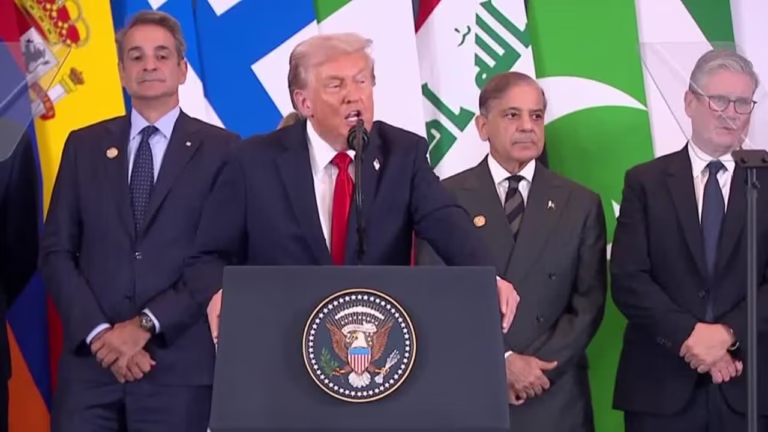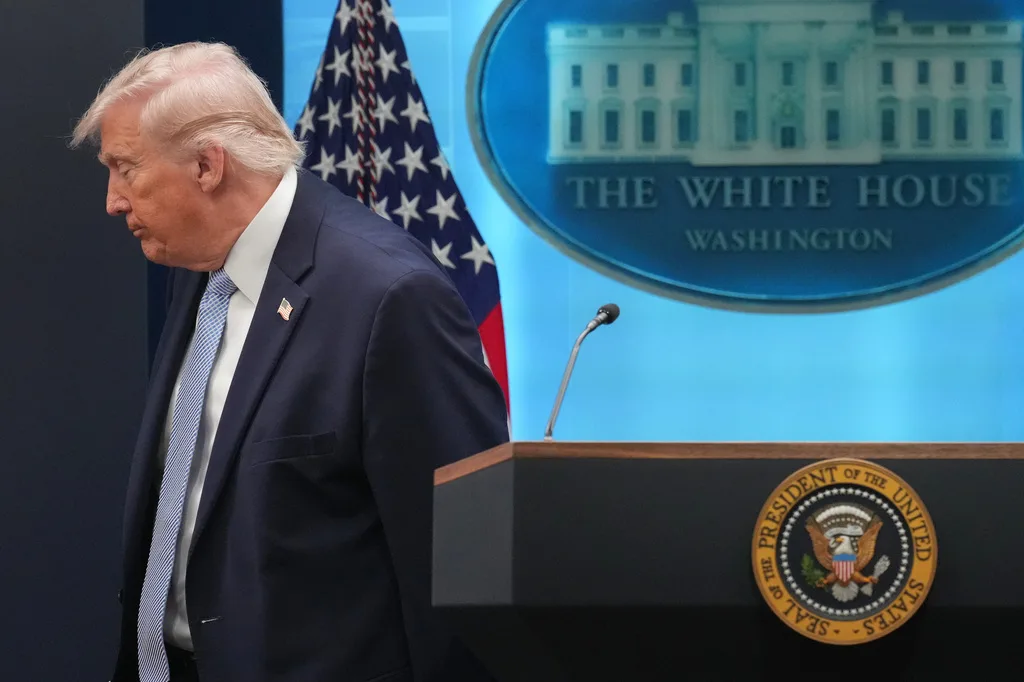
Washington, D.C. — A sharp escalation in political tensions has emerged following former President Donald Trump’s reported statement warning that “an entire civilization will die tonight” in reference to Iran.
The remark has triggered widespread concern among lawmakers, policy experts, and international observers, prompting dozens of Democratic legislators to call for his removal from office through the 25th Amendment of the U.S. Constitution.
What began as a controversial statement has rapidly evolved into a broader debate about presidential conduct, national security, and the limits of executive power.
The immediate backlash centered on the tone and implications of the statement, which critics argue reflects a dangerous level of rhetoric at a time of already heightened tensions in the Middle East. Analysts warned that such language, particularly when associated with a U.S. president, could be interpreted as a signal of military intent, potentially destabilizing an already fragile geopolitical environment.
Concerns have been amplified by the strategic importance of the region, including the Strait of Hormuz, a critical artery for global energy supplies, making any escalation not only a regional issue but one with worldwide economic and security implications.
In response, Democratic lawmakers moved quickly to frame the issue not merely as a political disagreement but as a matter of presidential fitness. Several described the behavior as erratic and alarming, arguing that it raises legitimate questions about judgment and decision-making capacity in moments of crisis.
This shift in framing is significant, as it moves the conversation beyond policy critique into constitutional territory, where the mechanisms for addressing presidential incapacity become relevant.
Central to this debate is the 25th Amendment, which allows for the transfer of presidential power if the president is deemed unable to discharge the duties of the office. While the amendment has been invoked temporarily in cases such as medical procedures, it has never been used to permanently remove a president against their will.
For such a process to proceed, it would require the Vice President and a majority of the Cabinet to formally declare the president unfit, a threshold that presents both legal and political challenges. As such, while calls for its invocation are symbolically powerful, their practical implementation remains uncertain.
The situation has also revealed subtle shifts in political dynamics. Although the calls for removal are being led by Democrats, there have been indications of concern among some Republican figures and former allies, suggesting that unease over the implications of the statement may not be entirely confined to partisan lines.
This cross-party discomfort, while limited, underscores the seriousness with which the issue is being viewed in certain quarters of the political establishment.
Beyond domestic politics, the international dimension of the controversy remains a critical factor. Diplomatic analysts have cautioned that rhetoric implying large-scale destruction could be misinterpreted by foreign governments, increasing the risk of miscalculation.
In an era where communication is instantaneous and highly visible, statements made by political leaders carry amplified consequences, particularly when they involve adversarial nations.
Despite the intensity of the reaction, significant institutional barriers remain. The 25th Amendment is deliberately structured to require consensus among top executive officials, ensuring that it cannot be easily used as a political tool.
This design makes any attempt to remove a president through this mechanism both rare and difficult, reinforcing the likelihood that the current calls may function more as political pressure than as an immediate path to action.
As the situation continues to develop, it highlights enduring tensions within the American political system regarding accountability, executive authority, and crisis leadership.
Whether this episode results in concrete constitutional action or remains a moment of heightened political confrontation, it has already contributed to a broader and ongoing debate about the standards expected of those in the highest office and the mechanisms available to address perceived failures in leadership.

This is Kyle Thomas, a professional writer, and a news editor. I started my career as a blogger who writes on various topics and then I decided that I should join a NEWS agency where I can work as a NEWS reporter. So, I joined a renowned agency in the town as an internet and after getting 2 years of experience, now I am working as a senior NEWS reporter for The Daily NEWS Times.